 admin
admin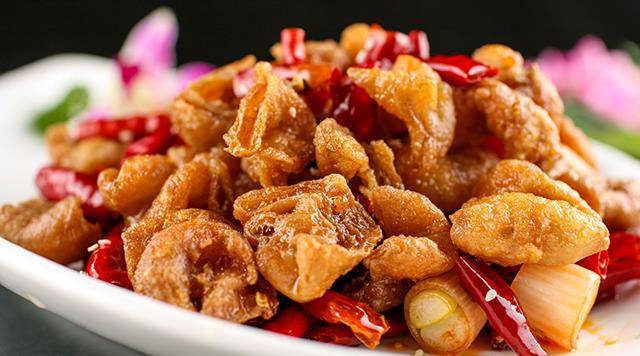
A deep look at one of Sichuan’s most beloved and least glamorous dishes — from the labor of preparation and the science of the fry, to the street stalls, home kitchens, and noodle bowls where crispy feichang has earned its place at the table.
The Ingredient Nobody Wants to Talk About
There are foods that announce themselves with beauty — a plate of delicate dim sum, a perfectly lacquered Peking duck, a bowl of hand-pulled noodles in clear broth. And then there is feichang (肥肠), pork large intestine, which announces itself in an entirely different way.
Feichang is not a dish that makes a good first impression. The ingredient is unglamorous by any measure. Its function in the animal is not something diners generally wish to contemplate. Its preparation is laborious in a way that would discourage all but the most committed cook. Its smell, before it is properly cleaned and cooked, is aggressively barnyard. And yet across Sichuan — in street stalls and home kitchens, in casual lunch restaurants and late-night noodle shops — feichang is eaten with genuine, unself-conscious enthusiasm. The crispy version, xiangsu feichang (香酥肥肠), is considered by many Sichuanese cooks to be one of the most satisfying things their cuisine produces.
Understanding why requires setting aside the initial hesitation and asking what, exactly, happens to pork intestine when it is properly prepared and subjected to the particular alchemy of the Sichuan kitchen. The answer is a small culinary revelation.
— — —
What Feichang Actually Is
Pork large intestine occupies an interesting position in the taxonomy of offal. Unlike liver or kidney, which are solid organs with a relatively straightforward texture, the intestine is tubular, layered, and structurally complex. The outer surface is smooth muscle. The inner surface, once cleaned, is a slightly rough, folded membrane. Between these layers sits a generous amount of fat — this is where the name fei (肥, fat) comes from — which plays a crucial role in what the ingredient becomes when cooked.
In Chinese culinary tradition, no part of a slaughtered animal is wasted, and feichang has been eaten in various forms across China for as long as pigs have been raised. The techniques for preparing it vary significantly by region: braised in the red-cooked style of Shanghai, stewed with pickled mustard greens in Hunan, skewered and grilled on street corners in northern China. But it is in Sichuan that pork intestine has found perhaps its most celebrated preparation — and that preparation is built around the specific properties of intestine fat and what happens to it under extreme heat.
When pork intestine is properly cleaned, parboiled, and then deep-fried at high temperature, something remarkable happens to its structure. The outer muscle layer crisps and browns. The inner fat layer, which has been softened and partially rendered during the initial cooking stages, contracts and bubbles under the heat of the oil, creating a surface of extraordinary textural complexity — simultaneously crunchy, giving, and yielding. The fat that remains inside becomes molten and intensely flavored, concentrated by the cooking process into something richer than simple pork fat. The result, when properly executed, is a piece of food with one of the most interesting textures in Chinese cooking: a crisp shell that gives way immediately to soft, fatty, deeply savory interior.
— — —
The Labor of Love: Cleaning and Preparation
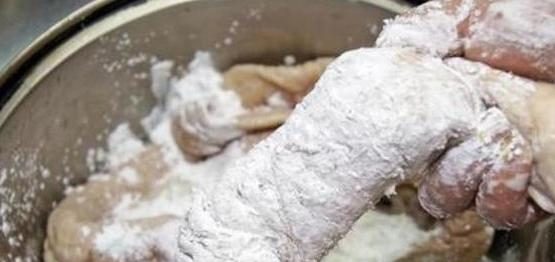
Before any of the flavor and texture of xiangsu feichang can be achieved, there is the matter of cleaning — a process that is, without exaggeration, the single most important and most demanding step in the entire preparation. It is also the step that most thoroughly explains why feichang is not served in more restaurants outside China: the cleaning is simply too much work for many professional kitchens to absorb.
The intestine must be turned inside out and scrubbed repeatedly to remove all traces of its original contents and the mucus membrane that lines its inner surface. This is done with a combination of salt, flour, and vinegar, each serving a specific function. Salt is abrasive and helps draw out moisture and impurities from the tissue. Flour acts as an absorbent, binding to the fats and residues on the surface and allowing them to be rinsed away more completely. Vinegar neutralizes odor compounds and helps break down the membrane, simultaneously acidifying the surface to inhibit any bacterial activity. The process is repeated — some cooks do three full cycles of salt-scrub, flour-scrub, and vinegar-rinse — until the water runs clear and the intestine smells clean rather than funky.
“The cleaning is the price of admission. It is what separates the cooks who understand feichang from those who merely tolerate it.”
After cleaning, the intestine is blanched in boiling water infused with ginger, scallion, and Sichuan peppercorn — the classic Chinese aromatic combination for neutralizing residual odor in offal. The blanching serves multiple purposes: it firms the tissue, making it easier to handle; it drives off any remaining volatile odor compounds through the heat; and it begins the cooking process that will eventually allow the fat layers to render correctly during the final fry. Some cooks blanch once and proceed directly. Others prefer a longer, slower initial cook — simmering the intestine for thirty to forty minutes in heavily spiced water until it is almost fully tender before frying, arguing that a longer first cook produces a more deeply flavored result and a more dramatic textural contrast when the intestine subsequently hits the hot oil.
The cleaned, blanched intestine is then cut into pieces — typically diagonal sections of about three to four centimeters, a cut that maximizes the surface area exposed to the hot oil and creates the cross-sectional view that shows the layered structure of the ingredient most clearly. At this stage, before the final cook, a piece of properly prepared feichang is already quite different from its raw form: pale, firm, smelling of ginger and peppercorn, with a slightly translucent quality at the cut edges where the fat has begun to clarify.
The Fry: Where Everything Comes Together
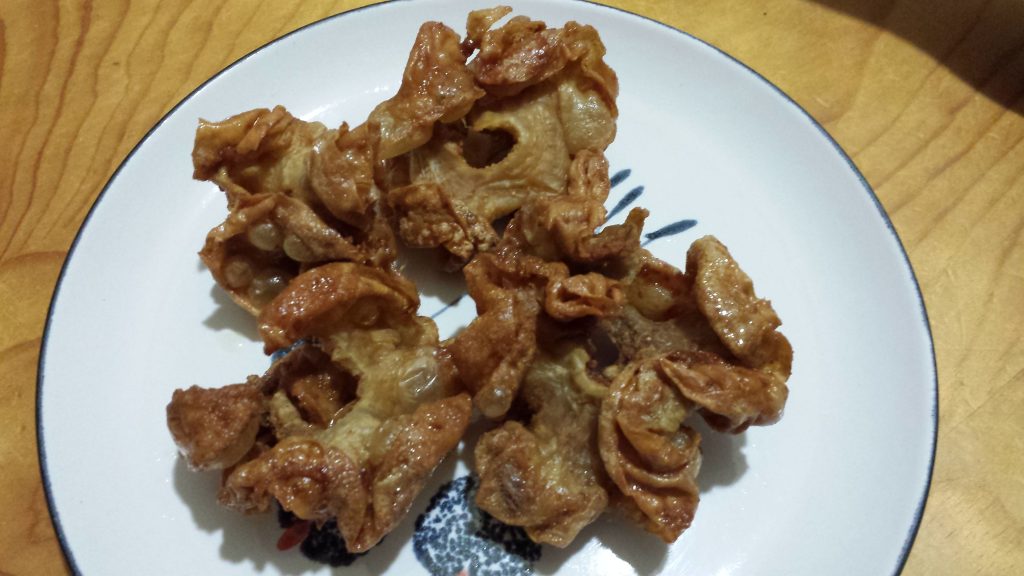
The word xiangsu (香酥) in the dish’s name contains its culinary promise: xiang means fragrant, aromatic; su means crispy, crumbly, yielding in a specific way that is distinct from Western concepts of crunch. Su texture in Chinese cooking is not the hard, glass-like crispness of deep-fried batter. It is more complex than that — a surface that shatters cleanly and immediately gives way, suggesting both integrity and fragility simultaneously. Achieving su texture in feichang requires oil at the right temperature and confidence about timing.
The intestine pieces go into oil heated to around 180°C — hot enough to immediately begin crisping the surface without leaving the interior cold or undercooked. They are fried in batches, never overcrowded, turned regularly to ensure even browning. Within three to four minutes, the transformation is visible: the surface darkens from pale to golden to a deep amber-brown, the outer muscle layer contracting and forming a wrinkled, slightly blistered crust. The fat inside expands slightly under the heat, pressing against the crisping outer layer in a way that creates the characteristic puffy, slightly uneven surface of well-fried feichang.
Many cooks use a double-fry technique — a first fry at slightly lower temperature to cook the intestine through and render the fat, followed by a rest period and a second fry at higher heat to achieve the final crisp. This is the same logic that underlies the best French fries and Cantonese twice-cooked duck: the first cook handles the interior, the second handles the surface, and attempting to do both at once invariably sacrifices one for the other. The rest between fries is not idle time — it allows the surface moisture to evaporate and the internal temperature to equilibrate, so that the second fry crisps more rapidly and more evenly.
— — —
The Seasoning: A Sichuan Conversation
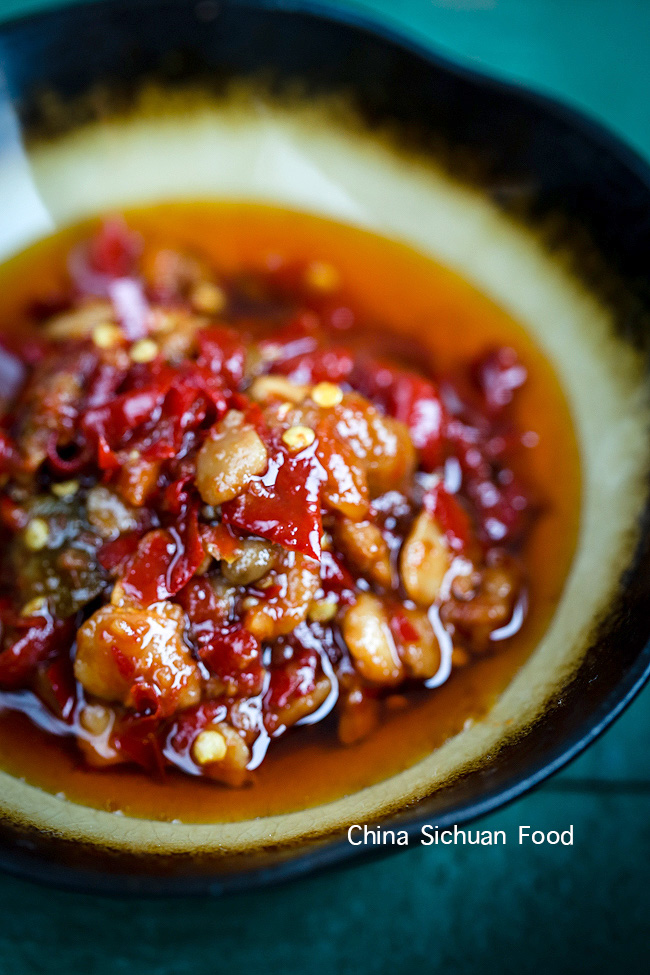
Crispy feichang is good on its own. With the right Sichuan seasoning behind it, it becomes something else entirely.
The most common approach is the dry-seasoning method, applied immediately after the intestine comes out of the oil while the surface is still hot enough to absorb aromatics. Ground Sichuan peppercorn and dried chili flakes are tossed with the hot pieces — the residual heat blooms the spices, releasing their volatile oils without burning them — along with salt, MSG (used without apology in Sichuan street cooking), and sometimes a pinch of five-spice powder. This combination, applied to the su surface of freshly fried intestine, produces a dish that is simultaneously crunchy, numbing, fragrant, and rich in a way that is difficult to stop eating.
The more elaborate preparation involves a second stage in the wok after frying. The crispy intestine pieces are added to a hot wok in which doubanjiang — Pixian fermented broad bean and chili paste — has been fried in lard or cooking oil until deeply fragrant. Garlic, ginger, dried chilies, and Sichuan peppercorn join the paste, and the fried intestine is tossed through this spiced oil until every surface is coated. The result is a dish of extraordinary intensity: the crispy texture of the intestine softened only slightly by the coating of spiced oil, the flavor a layered accumulation of fermented bean paste, chili heat, peppercorn numbness, garlic, and the deep pork richness of the intestine itself.
A third approach — popular in Chengdu’s more casual restaurants — finishes the feichang with a pour of hong you (红油), Sichuan chili oil made with dried chilies, Sichuan peppercorn, sesame, and star anise steeped in hot neutral oil. The chili oil does not crisp the intestine but it adds fragrance, color, and a slow-building heat that continues to develop on the palate long after the last piece has been eaten. Scallion and coriander are scattered over the top, their freshness cutting through the richness of the oil and fat. This version is less texturally dramatic than the dry-seasoned or wok-tossed preparations, but it has its own logic: the smooth, glossy surface of the oil-dressed intestine, the herbs bright green against deep red, is genuinely beautiful.
— — —
Feichang in the Sichuan Kitchen: Variations and Companions
Xiangsu feichang in its pure form — fried, seasoned, eaten immediately — is perhaps the most dramatic expression of the ingredient. But pork intestine appears in a wider range of Sichuan preparations, each exploiting a different aspect of its character.
Feichang Noodles: The Bowl That Defines a Morning
Feichang mian (肥肠面) — pork intestine noodles — is one of the defining breakfast dishes of Chengdu, eaten at wooden tables in small noodle shops that open before dawn and sell out by mid-morning. The preparation is different from the crispy version: the intestine is here braised slowly in a master stock seasoned with soy sauce, doubanjiang, sugar, Sichuan peppercorn, and various spices until tender enough to cut with chopsticks, then ladled over freshly cooked alkaline noodles in a soup made from the braising liquid thinned with stock. The result is something completely different in texture from xiangsu feichang — soft, yielding, almost melting — but the flavor DNA is the same: rich, peppery, deeply savory, the fat of the intestine dispersed through the soup and coating every strand of noodle.
Regular Chengdu feichang mian eaters have strong opinions about which noodle shops do it best. The debates are essentially religious in character — about broth clarity versus depth, about the ratio of intestine to noodle, about whether the intestine should be sliced or served in whole sections. This is the level of investment that Sichuan people bring to a bowl of noodles that costs a few yuan and takes perhaps ten minutes to eat.
Dry-Pot Feichang: The Social Version
Gangguo feichang (干锅肥肠) — dry-pot pork intestine — is the version served at the center of a Sichuan table for sharing. Here the intestine, fried crispy, is combined with vegetables — lotus root, potato, dried tofu, green chili — in a wok sauce of doubanjiang, garlic, ginger, and spices, cooked until the vegetables are just tender and the intestine has absorbed the sauce while retaining most of its texture. The dish arrives in a small wok over a flame, keeping it hot throughout the meal. As the table eats from the pot, the sauce reduces and concentrates. By the end, the last pieces of intestine and vegetable are coated in a thick, intensely spiced residue that many people consider better than the beginning of the dish. This is one of the reliable pleasures of gangguo cooking: it improves as it sits.
— — —
The Street Stall and the Night Market
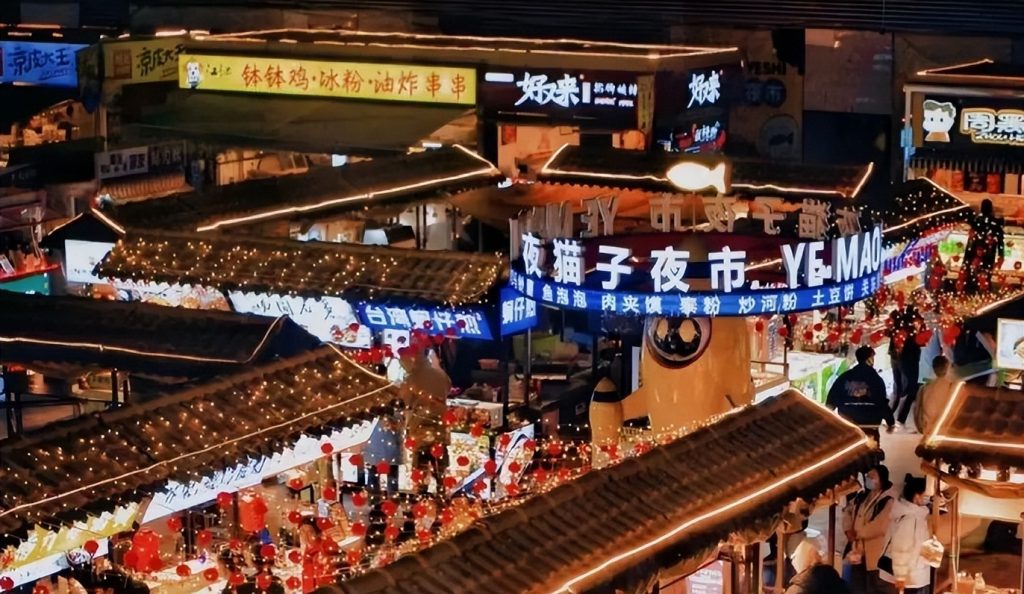
Feichang is fundamentally street food. This is not a criticism but a description of where the dish is most at home: at a small stall, eaten standing or on a plastic stool, from a paper tray or a polystyrene box, without ceremony.
The night markets of Chengdu — particularly around Jinli Ancient Street, Kuanzhai Alley, and the residential neighborhoods around Sichuan University — have feichang vendors whose setups are a study in operational efficiency. A wok of oil at constant temperature. A tray of cleaned, pre-cooked intestine sections ready to be fried to order. A small station of seasonings — chili, peppercorn, salt — applied with practiced speed. The whole operation takes perhaps five minutes from order to hand-off. The customer waits in a cloud of fragrant oil smoke that is itself a form of advertisement, impossible to ignore.
These vendors know things that no written recipe captures: the exact color of the intestine surface that indicates it is ready to come out of the oil, the particular way the pieces sound when shaken in the seasoning bowl, how the smell changes in the seconds before the spices are about to burn. This knowledge is tactile, sensory, accumulated through repetition. It is the kind of expertise that makes the difference between feichang that is merely competent and feichang that makes you stop mid-bite and reconsider your feelings about pork intestine.
The social context of street feichang is also part of the experience. Night market eating in Chengdu is communal and unhurried. Tables of friends share various items from different stalls, passing things across, arguing about which version of feichang is better, ordering seconds. The willingness to eat feichang in public, without embarrassment, in the company of friends, says something about how Sichuan people relate to the less glamorous parts of their food culture: with directness, pleasure, and a certain pride.
— — —
The Question of Squeamishness
Any honest piece of writing about feichang has to address the fact that a significant portion of the global population will not eat it, has never eaten it, and has no intention of starting. The reasons are cultural as much as sensory: in many Western food traditions, offal in general and intestines in particular have been progressively abandoned over the past century, associated with poverty, with parts of the animal deemed unworthy, with a level of bodily intimacy that modern food culture has largely trained people to avoid.
This is a relatively recent development and a geographically limited one. In France, andouillette — a sausage made from intestine with essentially no attempt to disguise the fact — is a beloved regional specialty. In Mexico, tripas are a standard taco filling. In much of Southeast Asia, offal is central rather than peripheral to the cuisine. The Western squeamishness about intestine is not a universal human response but a culturally specific one, and it is worth examining rather than simply accepting.
What underlies the discomfort is usually a combination of associations (what the intestine does in the body) and unfamiliarity (never having encountered the ingredient prepared well). The first objection cannot be argued away — it is visceral, and visceral responses are not fully amenable to logic. But the second can be addressed by the food itself. A piece of properly made xiangsu feichang, encountered without preconception, is an experience of texture and flavor that is hard to refuse on its own terms. The crunch, the richness, the numbing heat of the peppercorn, the deep savory concentration of the fat: none of these qualities depend on knowing what the ingredient is. They are simply good.
“The best argument for feichang is feichang itself. No amount of description substitutes for the first bite.”
The best argument for feichang is feichang itself. No amount of description substitutes for the experience of biting through a properly crisped piece and feeling the interior give way, tasting the concentration of pork fat and spice and peppercorn warmth. The cooks of Sichuan have known this for a long time. They do not spend much energy trying to convince people. They simply make the dish well and let the eating do the persuading.
— — —
A Defense of the Difficult
There is a case to be made — and Sichuan cuisine makes it implicitly, through dishes like feichang — that the most interesting food is often the most demanding: the ingredient that requires the most labor to prepare, the most skill to cook, and the most openness to appreciate. Easy food is rarely the food people remember. The dishes that stay with you tend to be the ones that asked something of you first.
Xiangsu feichang asks quite a lot, at every stage. It asks the cook to do unglamorous, time-consuming work with an ingredient that offers no visual reward until the very end of the process. It asks for precision in the fry and confidence in the seasoning. And it asks the diner to set aside whatever hesitation they bring to the table and simply eat.
In Sichuan, this is not considered a remarkable request. The province has always had a direct relationship with the full range of what food can be — a willingness to find value and pleasure in the parts that other cuisines overlook. Feichang is perhaps the clearest expression of this philosophy: an ingredient that is, by any conventional standard of culinary glamour, deeply unglamorous, transformed by knowledge and skill and fire into something that people seek out, argue about, and eat with unrestrained pleasure.
That transformation is what cooking is for. And few things in the Sichuan kitchen demonstrate it more completely than a plate of xiangsu feichang, still hot from the oil, smelling of peppercorn and chili, waiting for the first bite.